

Materiality
Our Sustainability Approach
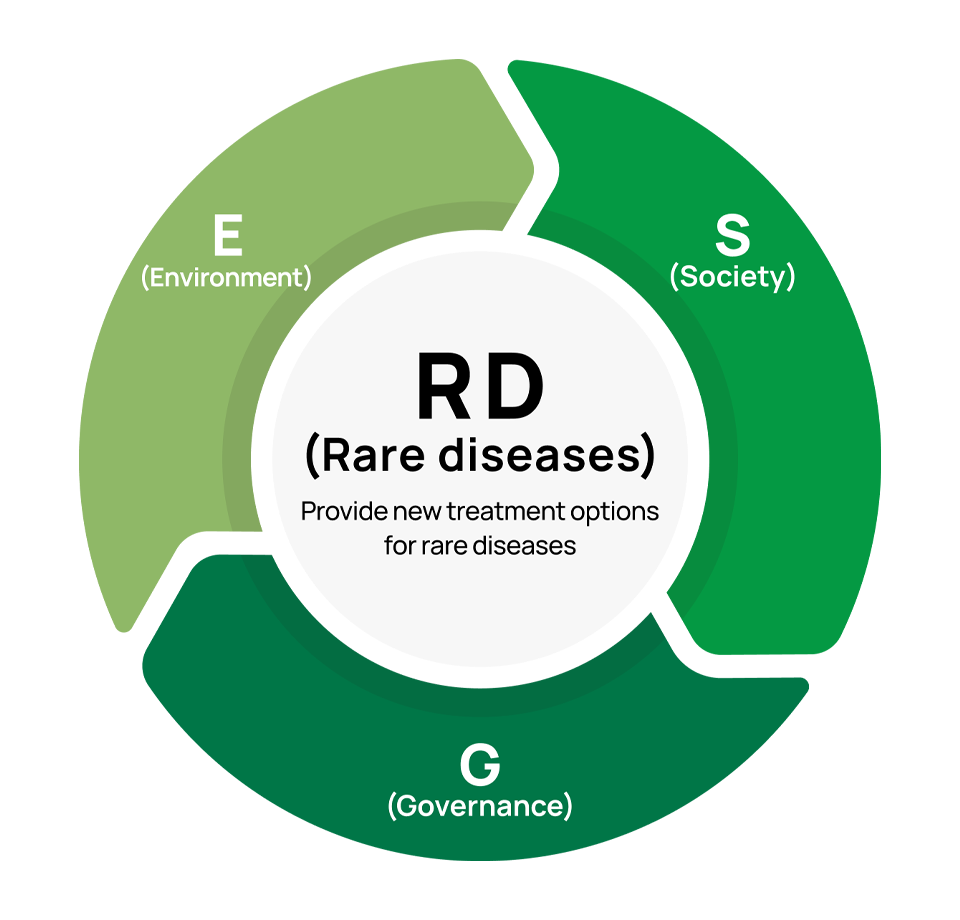
Since its inception in 1975, JCR has sought to create groundbreaking therapeutics that address unmet medical needs, particularly in the rare disease field. To this end, we have been harnessing forward-looking biotechnologies, as well as technologies for cell therapy and regenerative medicine.The global environment and conditions and issues facing society have been changing year by year, but JCR believes that it is crucial to create sustained corporate value through its business activities as a pharmaceutical manufacturer and contribute to the development of a sustainable society, and is implementing activities in the core areas of Rare Diseases, Environment, Society, and Corporate Governance. Rare Diseases, in particular, are closely related to JCR’s business activities and are a domain to which JCR can especially contribute. In addition to developing treatments for ultra-rare diseases and building new business models, JCR has also worked to improve access to medicines. We will proactively engage in things that only JCR can provide even for ultra-rare diseases where there are only few patients as we aim to achieve a society where no one will be left behind.
RD (Rare Diseases)
As of March 31, 2025

| Materiality | Major Initiatives |
|---|---|
| Provide new treatment options for rare diseases |
|
E (Environment)
As of March 31, 2025
| Materiality | Major Initiatives |
|---|---|
| Consideration for the natural environment |
|
S (Society)
As of March 31, 2025
| Materiality | Major Initiatives |
|---|---|
| Platform Technologies |
|
| Scaling Biologic Therapies Globally |
|
| Human Resource Development to Support Growth |
|
G (Corporate Governance)
As of March 31, 2025
| Materiality | Major Initiatives |
|---|---|
| Upholding Ethical Leadership |
|
Process for Identifying Material Issues (Materiality)
JCR believes that it is crucial to continue pursuing the sustained creation of corporate value through its business activities,
thereby contributing to a sustainable society. To that end, JCR identifies the material Issues it should address through the process outlined to the below.
- Step 1List material Issues
- Step 2Assess material Issues
- Step 3Assign priority to material Issues
- Step 4Determine material Issues
Step 1List material Issues
Derive material Issues by referring to international guidelines, principles and frameworks, as well as conditions and challenges faced by the pharmaceutical industry, and from the perspectives of what JCR is uniquely capable of doing and what it should be doing.
Step 2Assess material Issues
Assess the importance of the material Issues derived in 1. from the perspective of their impact on society and the environment as well as their impact on JCR’s business.
Step 3Assign priority to material Issues
Based on the assessment in 2., organize material Issues into categories and assign priority to highly important material Issues for JCR from a long-term perspective, in light of JCR’s corporate philosophy, purpose, business activities, and Midterm Business Plan.
Step 4Determine material Issues
The issues identified in 3. are discussed and approved by the Board of Directors and are established as JCR’s material issues. The identified material Issues are explained and shared internally so that each employee can take ownership of each issue, and further enhancements are made. In addition, specific material Issues are shared with a wide range of stakeholders through disclosure via JCR’s website and other channels.
Addressing the SDGs
JCR believes that partnership and cooperation with the international community are the most important priorities for realizing sustainability. JCR proactively conducts sustainability initiatives, in keeping with the spirit of the SDGs of “no one will be left behind.” It shares with and returns to a wide range of stakeholders the achievements of these efforts.
